China Best Dog Kennel Outside for Global Buyers?

Time:2026-10-03 Author:Aria
0%

Choosing the right Dog Kennel Outside can shape a dog’s safety, comfort, and daily routine. For global buyers, China has become an important manufacturing source, offering varied designs, materials, and price ranges. Yet a low quotation does not always mean good value. Buyers must examine construction details, supplier experience, and long-term performance.

A reliable outdoor kennel should protect dogs from rain, wind, heat, and damp ground. Look for galvanized steel frames, corrosion-resistant coatings, secure doors, and smooth edges. A raised floor can reduce moisture during heavy rainfall. Ventilation matters too, especially in warm climates. Insulation may be necessary for colder regions. Small details count.

They do.

Experienced exporters should provide clear product drawings, material specifications, loading information, and inspection records. Factory photos help, but they are not enough. A video inspection can reveal welding quality, drainage design, and storage conditions. Independent testing may also support claims about strength and coating durability. Still, product standards differ between markets, so buyers should confirm local requirements before ordering.

China-based suppliers can support customization, including kennel size, roof style, color, packaging, and access panels. However, customization may increase production time and replacement difficulty. I have seen attractive designs fail because drainage was overlooked. That lesson deserves attention. Reliable purchasing depends on more than polished catalogs. It requires sample evaluation, careful communication, and realistic expectations about shipping, assembly, and after-sales service. This guide examines how global buyers can compare Chinese outdoor kennel suppliers with greater confidence and practical judgment.
China Best Dog Kennel Outside for Global Buyers?

What Makes China a Leading Source of Outdoor Dog Kennels?

China has become a leading source of outdoor dog kennels because its manufacturing network supports varied designs and order volumes. Buyers can compare welded steel panels, galvanized frames, insulated roofs, and modular runs from one supply market. This flexibility helps kennels fit family yards, boarding facilities, farms, and animal care projects.

Experienced suppliers usually discuss drainage, ventilation, gate placement, and cleaning access before production. A well-designed kennel should keep paws away from sharp edges and provide shade during hot weather. Powder-coated or galvanized surfaces can improve resistance to rain, but coating quality still needs inspection. Ask for material specifications, weld photographs, dimensional drawings, and sample testing. Documentation matters for reliable international purchasing.

Tips: Measure the installation area carefully. Request a pre-shipment inspection. Check packaging strength for sea transport. Confirm local safety requirements before ordering.

Customization is another reason global buyers consider China. Manufacturers may adjust panel height, roof angle, floor clearance, and feeding doors. However, customization can create mistakes when drawings are vague. I have seen attractive designs fail because drainage was overlooked. Clear diagrams and written tolerances reduce that risk. Buyers should also confirm replacement-part availability, assembly instructions, and after-sales communication. A lower price is useful, but only when durability and support remain acceptable.

Key Types of Outdoor Dog Kennels Available from Chinese Suppliers

Outdoor dog kennels from Chinese suppliers come in several practical types. Welded wire kennels offer strong ventilation and clear visibility. They suit warm climates and active dogs. Chain-link models usually reduce cost and allow flexible layouts. However, thin wire can bend under pressure. Buyers should check wire diameter, mesh spacing, weld quality, and frame strength.

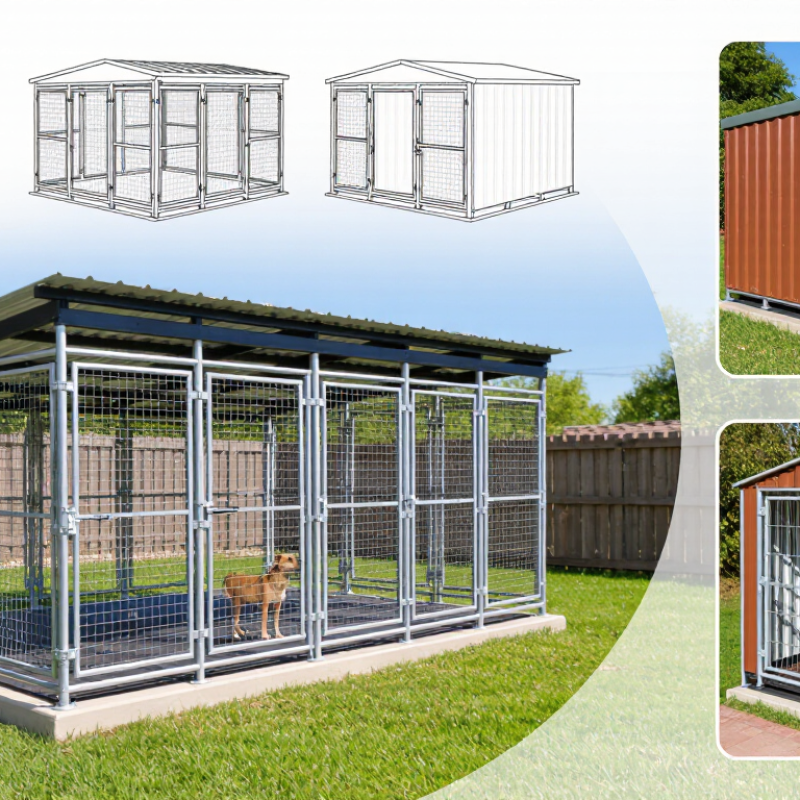
Panel kennels are easier to assemble and relocate. Steel panels with powder-coated surfaces resist ordinary moisture and scratches. Galvanized steel performs well in rainy areas, but exposed cuts may still rust. A roofed kennel provides shade and rain protection. Some designs use corrugated metal, while others combine steel frames with insulated panels. Insulation matters in regions with cold winters or intense summer heat. Ventilation still needs attention.

Concrete-base kennels suit permanent installations and frequent cleaning. Raised-floor kennels improve drainage and reduce contact with wet ground. Portable kennels work better for temporary use or changing layouts. They are convenient, but lighter structures may move during strong wind. This detail is often underestimated. Chinese suppliers can adjust dimensions, doors, roofs, and feeding openings for different markets. Reliable procurement requires drawings, material certificates, sample inspection, and photographs before shipment. Outdoor products are exposed to weather every day. A finish that looks excellent indoors may disappoint after one wet season. Buyers should test the complete structure, not only the attractive panels.

China Best Dog Kennel Outside for Global Buyers?

Key Types of Outdoor Dog Kennels Available from Chinese Suppliers

The chart compares representative outdoor kennel footprints commonly used for global purchasing specifications. Modular sizes such as 2×2 m, 2×3 m, and 3×3 m are practical configurations for single-dog housing, multi-dog runs, boarding areas, and larger working-dog enclosures. Actual dimensions, roofing, flooring, and panel materials should be confirmed with the supplier.

How to Evaluate Kennel Materials, Design, and Weather Resistance

China Best Dog Kennel Outside for Global Buyers?

For outdoor kennels, material choice affects safety, cleaning, and service life. Galvanized steel frames resist moisture better than untreated steel. Powder coating adds protection, but damaged areas may still rust. High-density plastic panels are lighter and easier to wash. They can become brittle under strong sunlight or freezing temperatures. Wood feels warm, but it needs regular sealing. Wet corners often reveal weak construction.

Design should match the local climate. Raised floors reduce contact with rainwater and cold ground. A sloped roof helps snow and water run off quickly. Ventilation openings should prevent drafts at the sleeping level. Secure latches, rounded edges, and smooth welds reduce injury risks. Check panel spacing carefully. A small gap can still trap a paw. I once underestimated drainage during a rainy-site inspection. That mistake changed how I assess kennel bases.

Tips: Ask for steel thickness, coating details, drainage drawings, and weather-resistance test records. Request close-up photos of welds, hinges, roof joints, and floor supports. Compare wind, snow, heat, and humidity conditions at the installation site. For coastal areas, stronger corrosion protection may be necessary. For hot climates, shade and cross-ventilation matter more than thick walls. Do not judge quality from appearance alone. A neat finish can hide thin panels or poor internal drainage.

Steps for Finding and Verifying a Reliable Chinese Manufacturer

Finding a reliable Chinese outdoor dog kennel manufacturer requires more than comparing online prices. The American Pet Products Association reported 65.1 million U.S. dog-owning households in its 2023–2024 National Pet Owners Survey. That large buyer base expects safer materials, stable production, and clear documentation.

Request the factory’s legal registration, production address, export history, and quality records. An ISO 9001 certificate can support process control, but it does not prove kennel safety. The ISO Survey 2023 recorded over 1.26 million ISO 9001 certificates worldwide, so certificates must be checked with the issuing body.

Ask for recent factory videos, welding photographs, coating specifications, and test reports. Do not trust polished photos.

Order a paid sample before signing a large contract. Check weld smoothness, gate alignment, mesh spacing, drainage, sharp edges, and corrosion resistance after outdoor exposure. Confirm dimensions with a ruler, not only a drawing. Require an independent pre-shipment inspection that measures quantity, packaging, materials, and workmanship against an approved sample. A supplier should explain its corrective-action process when defects appear. That response often reveals more than a sales presentation. I would also compare two production batches, because one excellent sample can create false confidence. Country-of-origin rules, labeling, and safety requirements still depend on the destination market, so verify them with qualified local professionals before shipment.

Import, Quality Control, and Delivery Considerations for Global Buyers

China Best Dog Kennel Outside for Global Buyers?

For global buyers, the best outdoor dog kennel is rarely the cheapest quotation. It must survive handling, weather, assembly, and daily cleaning. The APPA 2023–2024 National Pet Owners Survey reports that 66% of U.S. households own a pet. This demand increases pressure on importers to deliver safe, durable housing. Before ordering, request material specifications, tube thickness, weld photographs, coating details, drainage design, and packed dimensions. A sample kennel should be assembled before mass production. Small problems become expensive in a full container.

Quality control should combine factory checks with independent inspection. Verify measurements against approved drawings, test door locks repeatedly, and inspect sharp edges, rust points, gaps, and roof drainage. Coating adhesion and corrosion resistance deserve written test evidence. However, laboratory reports do not replace physical inspection. That is an easy mistake. The World Bank’s Logistics Performance Index 2023 shows that customs, infrastructure, and shipment tracking strongly affect international supply chains. Buyers should confirm HS classification, export documents, pallet limits, and destination import requirements before payment. Requirements vary by country.

Delivery planning needs practical detail. UNCTAD’s Review of Maritime Transport 2023 notes that over 80% of global merchandise trade by volume moves by sea. Use moisture protection inside containers, corner guards, clear carton labels, and spare fasteners. Confirm whether the shipment is delivered to a port, warehouse, or final address. A lower factory price can disappear through repacking, storage, demurrage, and local delivery fees. The uncomfortable part is that no supplier can eliminate every transport risk. A written contingency plan still helps.

China Best Dog Kennel Outside for Global Buyers? - Import, Quality Control, and Delivery Considerations for Global Buyers
Evaluation Dimension Buyer Requirement Typical Export Benchmark Recommended Verification Method Import, Quality, or Delivery Impact
Outdoor Structure Weather-resistant construction suitable for long-term outdoor use. Welded steel or aluminum frame; corrosion-resistant surface treatment; covered roof option for sun and rain protection. Review material specifications, coating details, weld photographs, and an outdoor exposure sample where practical. Stronger corrosion protection can increase unit cost but may reduce replacement and maintenance expenses.
Metal Protection Protection against rust in humid, coastal, or wet climates. Hot-dip galvanizing, electro-galvanizing, powder coating, or a suitable multi-layer system. The selected process should match the destination climate. Request coating thickness records, surface-preparation details, salt-spray results when specified, and checks for exposed cut edges. Surface treatment affects production time, packaging requirements, appearance, and expected service life.
Animal Safety No sharp edges, dangerous gaps, unstable panels, or toxic accessible finishes. Rounded or protected edges, secure latches, smooth welds, escape-resistant spacing, and non-toxic finishes intended for animal-contact areas. Conduct dimensional checks, manual edge inspections, latch-cycle testing, and review destination-market animal-welfare requirements. Safety revisions after production can cause rework, delayed shipment, or customs and liability concerns.
Size and Usable Space Space appropriate for the dog’s size, activity level, and time spent in the kennel. Confirm internal length, width, and height rather than relying only on external dimensions. Allow room for standing, turning, lying down, and movement. Approve a dimensioned drawing, including door opening, roof overhang, floor clearance, and panel thickness before production. Larger dimensions increase material usage, cubic volume, pallet count, and freight cost.
Floor and Drainage Easy cleaning with reduced water accumulation and reasonable animal comfort. Optional raised floor, removable tray, sloped surface, drainage opening, or compatible outdoor flooring system. Check drainage direction, load capacity, cleaning access, tray fit, and resistance to deformation under the stated load. Floor systems may add packaging volume and assembly steps but can improve hygiene and maintenance.
Roof and Climate Adaptation Protection from rain, strong sunlight, snow, and regional weather conditions. Weather-resistant roof panel, adequate slope, secure fasteners, and optional insulation or ventilation according to climate. Verify roof material, panel overlap, fastener corrosion resistance, wind-load assumptions, and snow-load requirements for the destination. Roof upgrades may require stronger frames and larger cartons, affecting both production lead time and freight volume.
Quality-Control Plan Consistent quality across repeated production batches. Pre-production approval, in-process inspection, final random inspection, and documented checks for dimensions, coating, welding, hardware, and quantity. Use an approved inspection checklist, photo records, measurement reports, and an agreed acceptance standard before shipment. Inspection before shipment can identify defects while correction is still less expensive than destination rework.
Testing and Sampling Evidence that the finished product matches the approved specification. Production sample or first-article inspection for new designs, followed by batch checks for critical dimensions and safety components. Compare the production sample with signed drawings, approved materials, photographs, and packaging instructions. Sampling is particularly valuable for customized kennels, mixed-size orders, and first-time import programs.
Packaging for Export Protection from abrasion, moisture, impact, and missing hardware during international transport. Protective wrapping, corner protection, separated metal parts, labeled hardware bags, reinforced cartons or pallets, and moisture control where needed. Approve packaging photographs, carton dimensions, gross weight, stacking method, and a complete packing-list format. Better packaging reduces damage claims but can increase dimensional weight and warehouse handling requirements.
Wood Packaging Compliance Compliance when wood pallets, crates, or skids are used. Wood packaging may need treatment and marking under ISPM 15 requirements, subject to the importing country’s rules. Confirm the importing country’s requirements and request clear photographs of applicable treatment marks before loading. Non-compliant wood packaging can lead to inspection, treatment, re-export, or shipment delays.
Order Quantity Commercially viable quantity without creating excessive inventory. Minimum order quantities vary by material, customization, packaging method, and production setup. Mixed-size loading may be negotiable. Request a written quotation showing minimum order quantity by model, setup charges, sample charges, and mixed-container conditions. Larger orders can improve unit pricing, while smaller orders may carry higher setup and freight costs per unit.
Production Lead Time A schedule aligned with retail launch, seasonal demand, or project installation. Standard production often requires several weeks after drawing approval, deposit receipt, and material confirmation; customized designs usually require more time. Obtain a milestone schedule covering approval, material purchasing, production, inspection, packing, and dispatch. Late design approval or delayed deposit can move the production slot and the planned vessel departure.
Shipping Method Balance between cost, transit time, and shipment size. Sea freight is commonly used for bulky orders; air freight may suit samples or urgent small shipments but generally costs more per kilogram. Compare quotations using the same Incoterm, port pair, cargo dimensions, gross weight, and service scope. Kennels are often volume-sensitive products, so carton dimensions can materially affect freight cost.
Incoterms and Charges Clear responsibility for transport, insurance, customs clearance, and delivery. Confirm whether the quotation is EXW, FOB, CIF, DAP, or another agreed Incoterm. Import duties, taxes, destination fees, and unloading may remain separate. Request a landed-cost worksheet showing product price, origin charges, freight, insurance, customs fees, duties, taxes, and final delivery. A lower product price does not necessarily mean a lower total landed cost.
Import Documentation Documents that support customs entry and cargo reconciliation. Common documents include commercial invoice, packing list, transport document, and, where applicable, certificate of origin and product-specific declarations. Confirm document requirements with the destination customs authority, customs broker, carrier, and importer of record. Incorrect descriptions, quantities, values, or weights can cause customs queries and clearance delays.
HS Classification Correct tariff classification for the complete kennel and its components. Classification depends on material, construction, use, and how the importing country treats assembled or unassembled goods. Have the importer or customs broker confirm the applicable HS code before commercial shipment rather than relying only on a supplier estimate. HS classification can affect duty rate, import controls, documentation, and customs valuation.
After-Sales Support Practical resolution of missing, damaged, or replacement parts. Maintain a spare-parts list for panels, connectors, hinges, latches, screws, trays, and roof components, with clear part numbers. Include replacement procedures, claim deadlines, photo requirements, and responsibility for defective or transit-damaged parts in the purchase terms. Standardized parts reduce downtime and simplify warranty or post-delivery service.

FAQS

Why do buyers source outdoor dog kennels from China?

China offers many designs, materials, and order quantities from one manufacturing market. Modular options are common. They can suit yards, farms, and animal care facilities.

Which kennel materials are suitable for outdoor use?

Welded steel panels and galvanized frames can provide practical durability. Insulated roofs improve comfort in changing weather. Coating quality still requires inspection.

What safety details should an outdoor kennel include?

Check for smooth edges, secure door locks, safe gaps, and stable panels. The kennel should offer shade and fresh airflow. Small details matter.

How can buyers reduce customization mistakes?

Provide dimensional drawings showing panel height, roof angle, floor clearance, and gate placement. Write down acceptable measurement differences. Vague drawings invite problems.

What quality checks should happen before shipment?

Compare the finished kennel with approved drawings. Inspect welds, sharp edges, rust points, drainage, and coating adhesion. Open and close the door repeatedly.

Should buyers assemble a sample kennel first?

Yes, when possible. A sample can reveal poor drainage, missing parts, or difficult assembly. One small issue may multiply across a full shipment.

What documents should international buyers request?

Request material specifications, weld photographs, test records, packed dimensions, and assembly instructions. Confirm export paperwork and destination import requirements. Documents help, but they cannot replace inspection.

How can buyers protect kennels during sea transport?

Use moisture protection, corner guards, strong packaging, and clear carton labels. Include spare fasteners. Packaging is easy to underestimate.

What delivery costs should buyers calculate?

Include port handling, storage, repacking, local delivery, and possible delay charges. Confirm the final delivery point in writing. A cheap quotation may not remain cheap.

Conclusion

China has become a competitive source of outdoor dog kennels because its manufacturers offer diverse designs, flexible customization, and cost-effective production for global buyers. Available options may include metal-frame kennels, covered outdoor runs, modular panel systems, insulated shelters, and combination units with feeding or resting areas. When selecting a Dog Kennel Outside, buyers should carefully compare material strength, corrosion resistance, ventilation, drainage, roof protection, flooring, safety features, and suitability for different climates.

Finding a reliable Chinese manufacturer requires checking production capabilities, product specifications, sample quality, communication, and verified business information. Buyers should request clear quotations, confirm packaging and customization details, and establish quality-control procedures before mass production. They should also consider import documentation, shipping arrangements, lead times, inspection requirements, and after-sales communication. With careful supplier verification and a structured purchasing process, global buyers can obtain durable, weather-resistant kennels that meet practical use requirements and maintain consistent quality during international delivery.


Aria

Aria

Aria is a dedicated marketing professional with a deep passion for innovative strategies and a keen understanding of our company's product offerings. With a wealth of experience in the industry, Aria excels at crafting engaging content that highlights the unique features and benefits of our......